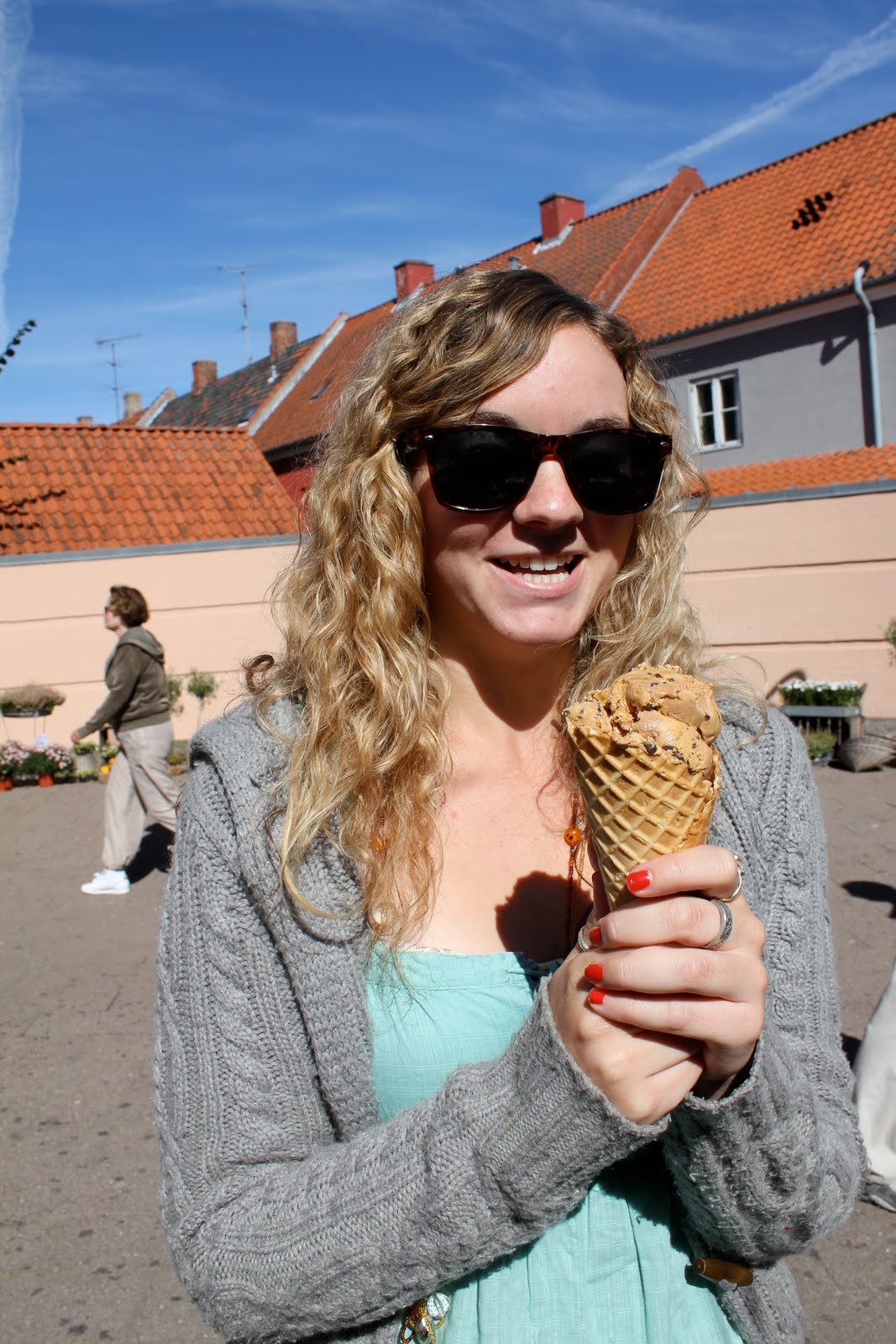
We left on Sunday night on the 3rd of October. Why night, you ask? Well, there were two study trips going to see the same places, and heaven forbid we ever see each other, so we went in reverse order. One group started nearby in Northern Germany and then worked away, while the other group started in far off Holland, and worked back. We were the 'lucky' group which started in the Netherlands and then came back. This actually could have been a good thing, given the right circumstances, but it meant that we left the night before the other group so we could 'sleep' (and yes, the quotation marks are intentional) on the bus. Anyone who knows me knows that I don't sit like a normal person. I curl up into a ball even when eating dinner. Well, when you sleep on a bus with someone next to you and someone putting their seat back ALL THE WAY all night long, curling is a problem. And keeping your legs straight means that you, as a midget, can't touch the ground and they dangle all night. Neither is a very comfortable option. So, I didn't sleep all that much. On the plus side, the really exciting part about the path from Denmark to the Netherlands from Sjælland is the ferry ride from Lolland (the island just south) to Germany. I mean, granted, we would go on this ferry ride either way, but it broke up the night bus travel at least a little bit. It is just a HUGE ferry boat- one that cars, buses, and A WHOLE TRAIN drive right on to. And then, the ferry pulls out of port, you get out of your car/bus/train for 45 minutes, and go up the the decks. Just like any other international cruise, it has a duty-free shop, a cafe, etc. And it's pretty fun to experience the sea wind on the open decks, if you brave the cold. After, back onto the cars/buses/trains, and off again. That part isn't as exciting. Nor is the rest of the 11 hour drive. Ew. They put on a couple bad movies. But all I really wanted was a bed, and to not have a person slammed up against me who I didn't know at all. Oh well. I think by 3 AM I actually fell asleep. Until we pulled into Rotterdam, NL at 7 in the morning. A whole 4 hours of sleep. Go me.
 |
| On the ferry! I think Bryan looks a little tired. |
So... Rotterdam. Yeah. How to explain it? From the standpoint of an architecture student, it's like they took all the models that students made in their first second-year studio (the ones that their teachers looked at, and sympathetically nodded at, knowing that it could never ever be built because it looks so ridiculous and would cost so much to make) and then decided it would be a good idea to blow them all up and set them down in one place. Architectural vomit capital of the world. Although I think segments of China are now on the verge of surpassing it. Anyway- some background on how anyone could ever let this happen. Rotterdam is in a particularly bad place if you happen to have a crazy national-socialist dictator who is currently trying to take over the world (and the only people really opposing him are in Britain). The Netherlands border Germany and are a short boat ride away from the UK. Not a good seat they chose (and... they really did CHOOSE it, but I'll get to that later). So, like many of the cities we visited, large parts of the city were completely destroyed. But from how I understood it, Rotterdam may have been one of the worst. Something like 95% of all of the buildings in the city were gone at the end of the war. This meant that in order to go on living, the entire city had to be rebuilt. Starting in the 1950's and 60's. NOT a good time to be building anything, from a stylistic point of view. We were well past the clean-cut modernists, and not even close to the technological streamlined age. So, a bunch of silly buildings with ridiculous shapes and colors (they love orange) began to emerge. Our hostel was no exception. Imagine my surprise to awake in the city of orange, twisting, turning, 1960's decorated skyscrapers after 4 hours of sleep to be told that THIS was where I would be spending the night:
 |
| 'The Cubes', as they are called. I wonder why...? |
We were so tired at this point that, had we been allowed to go put our stuff down, I think we would have all gone back to bed. But, being 7 in the morning, the hostel wasn't exactly down for that. SO, instead, we were given a room to toss our stuff in, and then we were fed breakfast. A good idea. It was what I have come to recognize as a pretty standard hostel breakfast. Cereals, coffees, breads, jams, etc. Delicious. And exactly what we needed (except for the sleep thing).
Then we were right away to see the Van Nelle (pronounced a little bit like 'vanilla') factory, which was a factory for a very large Dutch company which made tea, coffee, and tobacco. Aside from the Bauhaus (for non-architectural people, that is the famous founding school of the modern movement in architecture, in Germany), it is probably the best example of truly modern architecture in Europe. So much so that it is listed as a UNESCO World Heritage Site. It was beautiful! A super white building, separated into 3 sections, one for tobacco, one for tea, one for coffee, as well as other buildings which house all the other processes (administration, packaging, etc). There are also these really cool sky walks which stretch over the main road through the site from production to distribution. I guess they were something of an afterthought, but they really make the project. And honestly, with all of the glass and water, it was essentially a bunch of reflections, forcing you to look back in on yourself. I could have walked around there for HOURS.
 |
| The Van Nelle Factory. |
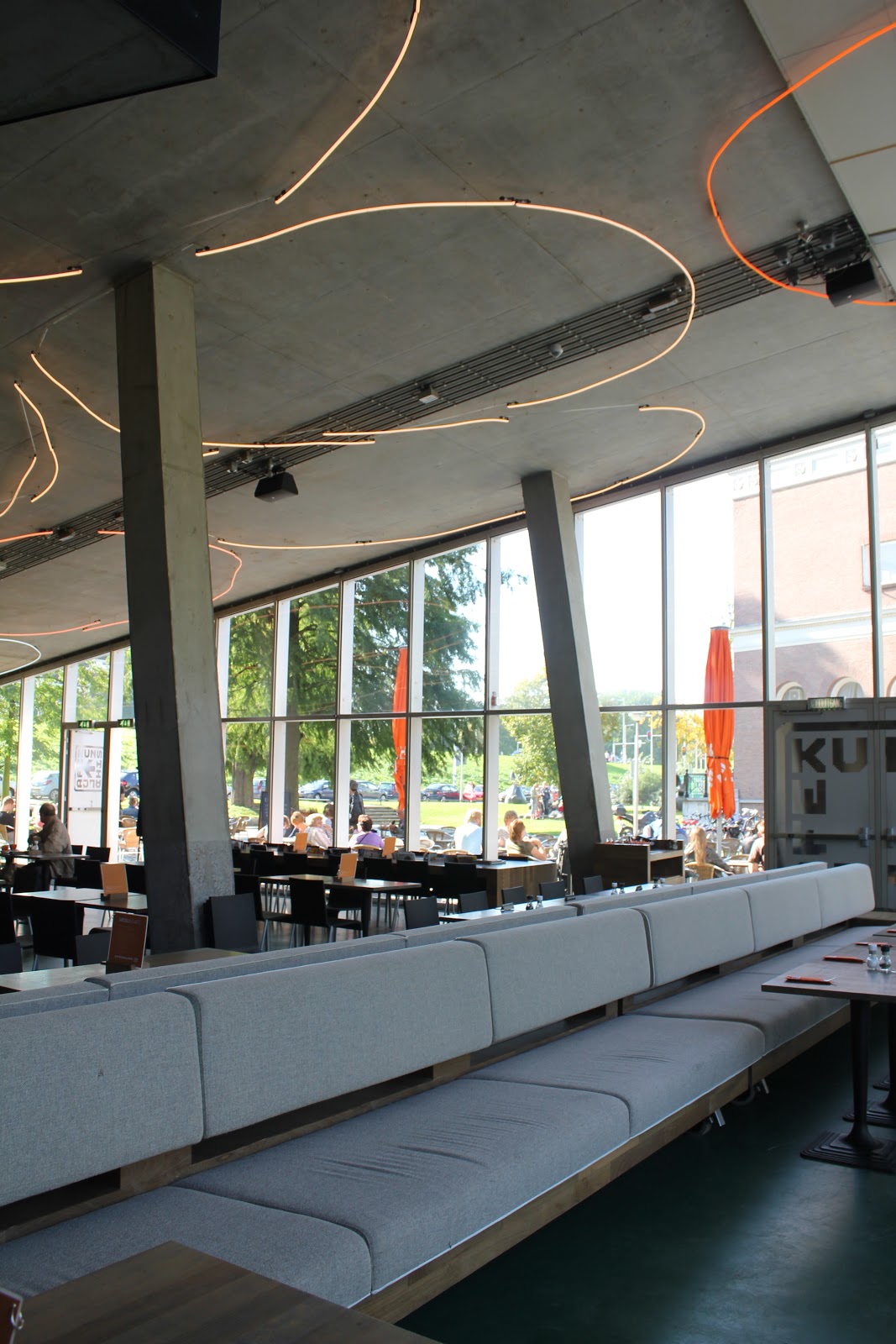
After, we headed back into the city center, and were let out to go see the Rotterdam Architecture Center, which was under construction, so we missed out. Instead, the people at RAC were really nice, and gave us free admission to one of their associated buildings, the Sonneveld House. It was designed in the 30's, I think, and again, was an incredibly modernist building. What was really cool was that they had preserved all of the Sonneveld families furnishings for the house, and had made the entire building a museum to the original design. And, like most modernist projects, it was a real gesamtkunstwerk, which translated from German to 'total work of art', and means that every aspect of the building, from the walls, to the sinks, to the furniture, and even sometimes the residence's cloths (!) were designed. Because it was so old, we had to wear these cool blue booties when we walked around inside. After, a bunch of us headed through the nearby park as a group. Just like pretty much everywhere in Europe, Rotterdam was undergoing construction, and unfortunately the park was being renovated when we went through it, meaning there were janky walls blocking many of the beautiful views, and our ability to navigate. But somehow we made it to the other side, which is the where the Rotterdam Kunsthal (designed by the famous Dutch architect Rem Koolhaas, and his firm OMA) lies. We were supposed to meet the tour leaders and the other students at the Kunsthal (by the way, kunsthal means art hall), but we were early. So, we went to the cafe and enjoyed some delicious food and drinks out in the beautiful Dutch weather. Oh, I forgot to mention that. Holland is NOT that far south from Denmark, and, as it was starting to get ever so nippy in Copenhagen, we mostly assumed that it would be chilly in Germany and the Netherlands as well. Well, for some reason, Holland happened to be having something of a heat wave while we were there. It was RIDICULOUS how hot and humid it was. I mean, given the clothes that we were wearing, we were burning up!
 |
| The inside of the cafe at the Rotterdam Kunsthal. |
Then, of course, we met up with the group and went inside. Unfortunately, no cameras were allowed in the galleries (which is a shame, not for the art, but for the building itself- there was a lot happening!) I did snap one photo in the auditorium, and I guess it's at least a hint of the way OMA designs, and the attitude of the Dutch people in general. Apparently, after WWII, with basically nothing left of any major city, the Dutch people were at a crossroads. They could give up, in complete despair, or they could roll up their sleeves, grow a big sense of humor, and start all over again. Obviously, they chose the second. Dutch architecture (at least, post-war architecture) is very fun, playful, and honestly, ridiculous. But that is sort of the national view on life. Why do it if you can't have a good time doing it? As they are constantly reminded, life is short, and it can end at any moment. Anyway, the building itself is always toying with the viewer. As you walk through the rooms, various elements play with you, trying to change how you see your self (specifically your size and your orientation) in the space. In one room, there are tall, wide tree trunks, exposing their texture, making you feel tiny. The walls where the art are hung are GIANT, and do the same. The next room is incredibly narrow and tall, and is composed of two floors- the second of which has a floor made of metal mesh, as so you can see the people walking below your feet! The whole room is incredibly bright, and it has the weird sense of floating on a cloud. Finally, the third gallery is really low-set but wide, and it has walls all over like a labyrinth. After all of this, you find yourself back at the auditorium, the beginning of the museum! It was incredibly bizarre. I actually had no idea how to navigate the building as I was doing it. I just sort of happened upon the exit. I don't love OMA aesthetically, but I have to admit I was perplexed and amused by this project.
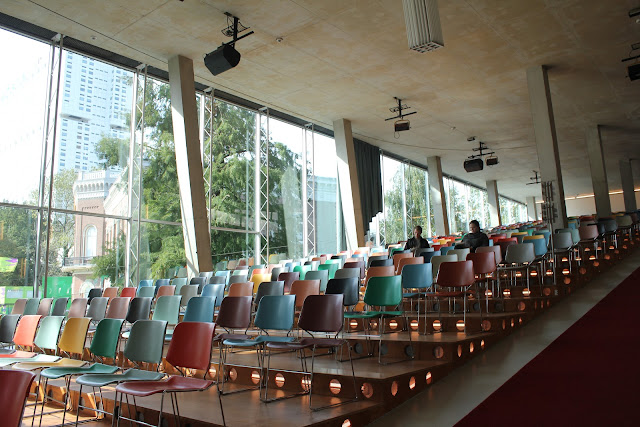 |
| The auditorium. You have to LOVE the Dutch sense of color! |
When we were all done here, we walked back to the hostel, which was surprising not that far away. We were then given a few hours before dinner to do what we wanted. To be perfectly honest, I am a little disappointed in myself. Instead of going out with some of the others to see more of the city, I stayed in the hostel and worked on my sketches from the day and RESTED. I was pretty tired. But looking back, there were parts of Rotterdam I never got to see.
Dinner was hilarious. I will try to be brief about the dinner adventures, but some of them really are worth noting. And this was one of them. Below our ridiculous sideways cube hostel, there was a restaurant facing one of the many (many, many) Dutch canals. We went inside, and because there were so many of us, were separated into two tables. We were STARVING! And so, when we ordered drinks, we all jumped on something sugary (I got iced tea), hoping food would come soon. And, after about 15 minutes of waiting, we all got really fed up and got ourselves some beers. I tried a Palm, which was actually quite delicious. And, after maybe 25 more minutes, our first course (this was a 3 course meal) came out. It was beef carpacio, which made the 40 minute wait hilarious. I mean, you don't even COOK it! Plus, they knew like weeks in advance that we were coming. Oh boy. But is wasn't over there. After a good hour more (and I'm really not exaggerating, we kept track) our second course, halibut with vegetables and a delicious cream sauce came. Now, don't get the impression that this was a large second course though. It was a serving of meat. Meaning, about the size of a deck of cards. But, it was also delicious. Finally, another hour later, dessert was served. I believe it was spice cake and banana ice cream, although that is just a guess based on the taste and texture. I know it sounds weird, but I could have eaten an entire tub of it. And not just because we were still starving at the end of the meal. What was nice about dinner being that long was that we actually all TALKED with each other, a habit I think most Americans have lost. We are kind of an eat-and-run nation, but here we got to know each other better, chat, laugh, and TASTE. That part of the meal I did like.
 |
| Dessert. Ice cream, whipped cream, and a paint stroke of Nutella. Yum! |
Bright and early, we were up, had our tasty tasty hostel breakfast, and then walked all the way to the other side of the city to catch a train from the Central Station. I guess they wanted us to see the station, but, eh, I wasn't that impressed. We got a train to Amsterdam (they come at least once every hour) and in 45 minutes, pulled into ANOTHER central station. This one was a lot nicer, considering it was really old- like a traditional industrial age train station. The light inside of the main hall was fabulous at this time of day, streaking though the wrought iron arches above us. The first part of the day we spent in a group, seeing some important architectural places that, let's face it, we would have ignored otherwise. We took a tram across the city towards the water to the residential islands. Specifically, we went to Java. But what is funny is that these DUTCH islands (and I don't mean like an island out in the ocean, they are just separated by small canals from the rest of the city) are named after African and East-Asian places- Java, Borneo, Suriname. I realize, of course, that is has to do with the Dutch traders, and their presence all over the world. But still, it was odd to go to Java, Amsterdam. Anyway, the islands, specifically Java and Borneo, were designed by one firm, but with the intent to create as much diversity as possible, and to create a sense of small scale urban fabric. To do this, they broke of the facades into smaller blocks with unique textures and colors. It was a very colorful place! Also, there were canals running through the neighborhoods, with a water on either side of the buildings. After walking through Java, and then Borneo, we went to the Lloyd's Hotel, which is now a hotel, but has changed uses several times. Originally it was actually the Dutch equivalent of Ellis Island! The Netherlands, by the way, is an incredibly diverse country. There is a very large non-ethnically-Dutch population, and a great deal of them are Muslim or Arab. We ate lunch at the Lloyd's Hotel, which was great, because the eating room is a large white atrium facing the water, with plenty of natural sunlight. It was a very pleasant place to sit! After, we were guided back to the city center, and then LET LOOSE, which, for a lot of people meant- coffee shops. And no, for those of you who don't know, you don't buy coffee at coffee shops. I can't be entirely certain of the validity of this assumption, but I gather that: when pot was made legal in the Netherlands, coffee shops were licensed to sell it. A some point, a schism occured which split coffee shops into those that sell pot and those that do not. Those that do kept the name of coffee shop, and those that do not switched to 'cafe'. Or it could have been the other way around, or something completely different, I don't know. But suffice to say that coffee shops sell pot, and cafe's sell coffee. An important distinction.
Anyway, when you go to Amsterdam with a bunch of young Americans, it's rather difficult to find company if you don't plan on smoking (as was my case). Even for those who have never smoked before, being in Amsterdam almost 'requires' that you try. In fact, of 25 people, I think only 5 decided to avoid the coffee shops. And, I personally don't care if the others want to go smoke or not, but 1.) the smell of marijuana makes me nauseous (yes, I know this is counter-intuitive), and 2.) even if it didn't, being around a bunch of high people when you are not is not that interesting. I am from Boulder. I have experience. Luckily, one of my friends, Bryan, who I enjoy a lot, wasn't into it either. We split off from the group and went to look for a cafe. We were tired and wanted to sit down, and figured caffeine was the perfect antidote. So, we wandered through the canals that run through the older part of the city (take a look at a map of Amsterdam- it is a fascinating set of rings formed by canals!), peaking into the shops, and trying to find a nice cafe. The shopping didn't go so well, unfortunately. We discovered that in this part of the city (which is mainly residential on the upper floors, and shops or cafes or restaurants below) had very expensive independent shops. Which meant that the clothes were very nice, but typically cost about twice as much as I would have been willing to pay for them. We had better luck with the cafe. We found one right along one of the more beautiful private canals, and although a small road separated the cafe from the water, all of the outdoor tables (and remember, it was really warm in Holland) were right next to the canal. We went in, very excited, and found a menu. There weren't really any coffee selections on the menu (it wasn't an Italian of French cafe), but we did see "hot chocolate"... followed by "hot chocolate with whipped cream"... followed by "hot chocolate with whipped cream and rum". We, obviously, chose the last one. Then, we took our drinks out to the tables, which were all full. Rather than go back inside to a table, we just sat down on the wall of the canal and camped out. It was amazing. From there, we could see all the way down the water, and the leaves were turning colors, and falling in. And, our rum/chocolate creation was SO good. And, surprisingly (for the price) very strong. I tasted a lot of rum.
 |
| The best hot chocolate. EVER. |
 |
| The Cathedral in Amsterdam at night. |
In the morning, we got BACK on the bus (oh bus, how I love and hate you), and drove off to Utrecht. Unless you know a lot more about the geography of Holland than me, you probably don't know that much about Utrecht. BUT, it is a small city with a very beautiful Cathedral, and a very large University. Also, it is home to the Rietvelt Schröder House, essentially the epitome of De Stijl architecture. De Stijl was a Dutch style of art and architecture which developed in the 1910's, and focused heavily on the use of lines, planes, and the colors red, blue, yellow, and black. We went to see the Schröder House first, and really- this is any architecture student's dream. We see it in class, and learn over and over again how influential it has been on the way we look at building, and then- there it is! We got a tour through the house, which, like the Sonneveld House, has been restored as a Museum to its original state, and got to wear cool blue booties again too. The top floor is especially impressive because it was designed to be completely flexible. The walls are all non-perminent, and fold up into themselves. So, the floor can be open as one big room, or closed off into a kitchen, bedrooms, and bathrooms. Our guide went through the process of closing up the floor for us. It was so exciting to see! Again, we weren't allowed to take pictures of the interior, because the images are sold in order to keep the museum open. But, it meant I had to focus on what was actually happening around me instead of seeing through a lens.
 |
| The Schröder House from the outside. An icon, for sure. |
After, we were taken to the University, which was ANOTHER project by OMA. I went on a sketching 'scavenger hunt' with some other students, and we went to three buildings in the process. We had a lot of fun attempting to make sketching a collaborative activity. The campus, espcially because it was in the middle of the day in the middle of the week, was very active. I wished I could have seen a little bit more of it honestly. But then, back on the bus and off to the Old City, where the Cathedral is. What is really cool about the old city- well, let me start again. There are a few things that are really cool about the old city. First, the Cathedral has an incredible tall tower. So much so that you can see it from almost anywhere. It is therefore a strong orienting landmark as you walk around. Second, the Cathedral as bombed (like everything else!) during WWII, and the Nave (that is, the main part of the church) was separated from the tower. Rather than rebuild, they have left it open , letting trees grow and putting up a statue. This space is now a very important plaza at the heart of the city. Finally, the canals in Utrecht and lower than in most Dutch cities. In fact, they are a full story below street level. This was done on purpose because the canals were once the main shipping route to the city, and lining the canal were a bunch of below-ground warehouses. So, if you take the stairs down to the water, there are buildings all along the water under the road! Most of them have now been converted into basements for the residential apartments at street level, or restaurants and shops. We were left to wander the city on our own until dinner. And it was by far the most beautiful place I saw in the Netherlands. I would go back in a heartbeat. Dinner was delicious, and by the time we were done it was very dark. We got back on our wonderful bus, and headed back to our last night in Rotterdam.
 |
| The canals of Utrecht. |