Showing posts with label Architecture. Show all posts

Saturday, October 2, 2010

Western Denmark

Hello again- I'm sorry this is coming so late (2 weeks later, in fact) but life has been very very busy since my short study tour (to Western Denmark) thanks to studio.  Ooooh architecture!

Anyway, DIS is designed specifically with study ABROAD in mind, and so our semester is set up to allow for 1 short study tour (with our core course), 1 long study tour (with our core course), and 2 weeks of travel break, where we can take part in DIS sponsored trips or go do our own thing.  Anyway, that adds up to almost 4 weeks of travel specifically planned into our curriculum.  Perfect.  So, the first study tour, the short one, is (pretty much for everyone... although, I heard of a few core courses that went elsewhere) to Western Denmark- specifically, Juttland (the peninsula) and Fyn (Funen in English... the island just to the left of Sjælland (Zealand, in English... that is, where Copenhagen is).  Each core course goes to see (unsurprisingly) things related to their field of study.  So, that meant I went out for 3 days and saw a LOT of architecture.  It was actually a very stressful 'vacation' because part of what we are required to do is sketch.  And I don't mean lazily or casually, or even relaxingly draw.  I mean speed sketching for accuracy and detail in a giant building, get sections, plans, elevations, perspectives, diagrams, etc etc ect- OH and don't forget to think about how you are laying out the page so there is some sort of organization to it.  You have 45 minutes- GO!  Not to be highly negative, but basically, you get to choose to SEE the building, SKETCH the building, or look at what's IN the building.  We went to a lot of art museums/galleries, and it came down to seeing the art or seeing the building.  Very sad, because typically (not always) they were both beautiful.  But, on the bright side, I think I have improved my drawing skills significantly, and my speed has probably quadrupled or more. 

Oh the places you'll go!

Ok, enough ranting.  (Although, now that you mention it- I'm very, very tired.  I have not slept much here.  But that's another story... mostly about studio, so you probably are not interested to hear it.)  Now down to business: the short study tour.  Essentially, I am going to briefly run down all of the stops we made, with one or two photos for each.  Like I said, if you want to know where these places are- go look it up yourself, you'll learn it better that way anyway.

1.) Orbæk Kirke, Orbæk, Fyn

Our first stop- a very, very traditional (and old!) church in a fairly small town.  Apparently, the sign of a church in Denmark is a stepped roofline.  Of course, new churches don't frequently do this, but being a few hundred years old, this was a good example of the style.  Apparently, however, it was not a static style, and traditional Danish churches typically underwent several constructions over the course of their lifetime- beginning with the basic nave (the long, tall part where people usually sit), then side entrances and spaces (usually making the building look like a cross in plan) as well as rooms for the priests, etc etc etc.  They are almost all white with a red tile roof, and- I learned this later, in Greve, but it's interesting anyway- the pulpet isn't at the front on axis as is typical of Latin or American churches.  The pulpet is off to the side in the middle of the congregation.  This means that people sit in front of and behind the priest while he gives his sermon.  Weird!  There were two things that I found especially nice about this church.  First of all, since Christianity was an imported religion (think of how far north this is!) the local peoples, who had their own sacred traditions, myths, and beliefs, interpreted the Bible and Christian ideals through the lens of their local worldview- aka, a world created by vikings, believing in Norse mythology, and having a very deep connection to the mystic and sacred forest.  The result of this is a very, very interesting translation of Christianity, which is apparent in the murals on the ceiling of the nave.  They include flowers, animals, the mother tree, and a really cool version of Jesus.  Secondly, the cemetery (and as I've learned, all traditional cemeteries in Denmark) was BEAUTIFUL!  I know, that is a strange thing to say, but trust me on this.  Each headstone got a little plot of land, differentiated by cute, short hedges, and then inside of the plot, there was room for personal decorations- flowers, vases, bushes, and even some ornamental trees!  So, it wasn't a field of stones, but a maze of intricate, person remembrances.  Some were very old, some very new, and you could always tell by the age of the plantings.  So cool.  I could have walked around and admired them for a long, long time,

Outside.  The stepped roof is the sign of a traditional Danish church.

The painted vaulted ceiling.  Now look very close to the center- this is Jesus. So completely cool.


2.) Fåborg Museum, Fåborg, Fyn

Quite obviously, a museum.  But specifically, an early century art museum, built by a man named (aptly) Fåborg.  He was good friends with a bunch of artists and sculptures, and he had a great deal of money. Unable to make it big elsewhere, they asked him to create a space to exhibit their work. And that he did.  It is designed in a very odd mish-mash of classical styles, using domes, vaults, arches, columns, long sight lines, level changes, and sudden turns.  It was sort of interesting to walk through, but also convoluted in a non-purposeful way.  The walls were especially interesting, because they were BRIGHT colors- bright blue, bright red, bright yellow, even black in a few places.  It was ostentatious in a minimalistic way.  I know that makes no sense, but it's hard to explain.  The art, in general however, was very beautiful, and the lighting qualities worked very well- particularly for the sculptures.  A few had very delicate lines which the direct light expressed quite nicely.  Post museum visit, we were invited to go explore the 'town' which was very awkwardly made so that it's only attraction (the museum) is on the other side of a long walking street from the town center where everything else worth seeing is.  Which meant with our limited time (and the slow steady rain outside) that most of us just stayed nearby and found a covered nook in which to eat our lunches.

I have no idea who this is a statue of, but he was so epic under this oculus.

Pretty typical of the museum- axial view to the distance and walls that are way too loud.  But, beautiful art.


3.) Trapholt Museum, Kolding, Juttland

This was one of my favorite stops of the trip- a modern Scandinavian furniture and art museum.  Like the Fåborg, constant level changes, and sudden and unexpected turns, but in such a clear way that it worked perfectly.  I felt to curious and playful the whole time I was in that building- I loved it!  Plus, the main axis (which was not a straight axis, but more of a bent line running across the site) was this amazing concrete vault that reminded me of the delicacy and understanding of Kahn.  As it went away from the main entrance, it got lower and lower (in response to the sight, sloping towards a large lake off in the distance).  The ceiling, however, stayed at a constant level- meaning that by the end of the museum, the vault is monumental- at least double height- and all the more forceful because the width has not changed at all.  The other rooms responded to this code, getting taller and taller as you move through the museum.  And, these rooms were all full of nooks and cracks and stoops, so that the furniture was incredibly playful with the building.  At times, the building becoming the artwork, and times the artwork becoming the museum.  I could have stayed there for hours upon hours.  But we only had 45 minutes there.  What a pity.  Some day I will have to go back.

The main spine through the building.


4.)  Glasmuseum Ebeltoft, Ebeltoft, Juttland

Just so you know- this happened on day two.  We got to Ebeltoft in the evening, found our hostel, was served a delicious Hostel mean (who knew!) and went to bed.  Early the next morning we packed up and were off again!  First stop was the nearby Glass Museum, which functions as an art museum which a permanent and rotating collection but ALSO as the studio for many local glass artists.  There are, therefore three main spaces- a rotating gallery, which is a new building, a permanent gallery, which is a very old (1920's) building which has been repurposed and linked to the new gallery, and a work studio, detached from the rest.  The buildings I thought were interesting at some level, but nothing really special.  It was the back greenspace and the artwork in the buildings that I really enjoyed.  The glass was AMAZING.  The rotating gallery contained a set of hyper-realistic plants- specifically, a cabbage field.  It was great.  In the permanent gallery, there were some great blown-glass pieces too.  If we hadn't been on a guided tour with a guide who was very adiment that we keep up with her, I would have broken off and enjoyed them.  The back yard was really nice too- especially since it had been raining on and off, making every color seem SO poignant.  The grass was amazing.  But what was really interesting was how geometric it was- with square plotting beds and very strategically planted trees.  It was such a change from typical gardens- it had the strong signs of human input.  At the end of tour, we got to go into the artist's studio where some glass blowers were making goblets.  I had never seen the process before and couldn't even believe that what they did was possible!  I love it.  This is something I really want to try myself now.

Those are the hyper-realistic cabbages.  On real peat moss.  See her diligently (er- frantically?) sketching in the background?

5.)  Design Højskolen, Randers, Juttland

Let me begin with some history (oh god, I know, not more history- I'm sorry, it doesn't make too much sense without it).  Once upon a time there was this very special Danish man names Nikolaj Gruntvig who did far too many things for Danish Enlightenment for me to go into.  He hated the way that traditional western schooling worked, and having seen alternatives in England, decided to develop his own.  He thought that everyone, especially common people deserved to learn about the world and study, in depth, so that they could experience worldly-, as well as self-, discovery.  So, he created this school in Rødding where people of any age (although mostly young people... and at the time only men... he wasn't THAT enlightened...) could go learn about STUFF.  It wasn't about grades, or tests, or competition, it was really preparing people to go out into the world.  It was called a folkhøjskole (this means "people's -aka common man's- high school"), and pretty soon they were all over.  Most Danish people who have just graduated from Gymnasium (there high school, essentially) go to one for about a semester before going on to further education (such as university, vocational school, or even
apprenticeship for a job).  There you can study whatever it is you want to study, with a GOAL in mind, but not exams, no grades, and no real pressure.  You have an open and equal relationship with peers and professors, and it's kind of like 6 months in an educational commune.  But, most people feel more prepared for the real world after it.  Anyway, they sometimes have themes.  The one we went to, for example, was a design school.  There were 3 fields of study to choose from- graphic arts, fashion, and architecture, and you spent 6 months there basically getting hands on experience about what it's like.  They say the focus is on process, not product, but there were some COOL things happening there.  The fashion students were hand screenprinting jackalopes.  Anyway, we were given a tour of the facilities, which I would say at least rival both my DIS and Cal Poly facilities (see- sometimes socialism works), and met a few professors and students.  It was a great place- out in the countryside on an OLD farm which had been converted (barn and all) into art spaces.  Loved it.  And to common facilities- like the cafe, central lawn, and lake were very nice as well.

The architecture experimentation room in the old barn.  Hilarious!

6.)  ARoS, Århus, Juttland

I will point out two things before I begin: 1, Århus is the second largest city in Denmark at 250,000 people.  2, Århus is pronouced "Or-hoos", which reminds me of the song "Our House" by Madness from the 80's.  And everytime I saw a sign that had the name the whole tour I got the song stuck in my head.  ANYway: So, ARoS is perhaps one of the more famous art museums in Denmark.  It's rather new, completed in 2004, and designed by the prominent Danish firm Schmidt Hammer Lassen (SHL), who also designed the Danish Royal Library (the Black Diamond) in Copenhagen.  Anyway, it is a BIG BRICK BOX.  And really.  I mean all three with capital letters.  It was pretty fun to look at actually, the texture and the weathering of the brick was nice (although after 6 years, there should NOT be that much discoloration on those bricks).  Plus, when you go inside the feeling completely changes.  It is starch white, and the atrium goes from the ground floor to the top floor- 5 stories up!  To be honest, as a museum I found it quite stupid.  As a sculptural piece it was great- I was awe inspired.  But the galleries became something completely other, disconnected from the narcissism of the atrium- like literally separated by big, thick walls.  It was as if the art were an afterthought.  I will say, however, that if you are ever in the 'big city', you should go just to see it- even if you just walk through the atrium and leave.  But if you go in, go to the bottom floor, where they have a standing exhibition called (at the moment) de 9 rum (the 9 rooms).  I was told by a fellow student that the space gets re-divided every year, adding a new room.  So, soon it will be de 10 rum... although I'm only passing on what she said.  I don't know that for certain.  All I DO know is that that exhibit was INSANE.  It was like being in a haunted house- I have never felt so uncomfortable walking through a gallery ever.  There were hallways that led from room to room, but everything was so dark, and you had no idea if there were people around you or not.  It was just blind movement, hoping you would stumble upon something.  And when you did, you weren't sure if you should look or run past.  I went by one room which was fitted out like a 1950's living room, with a couch, tv, ugly throw pillows, the works.  And, two motionless people watching the tv.  There was about a 10 cm level change up to go into the room, so I didn't really know if I could go in or not.  And, not going to lie- the two people, pale in the tv glow and motionless looked like eerie wax figures.  So I stood and watched anxiously for like 4 minutes trying to decide if they were real.  In the end, they were actual human people, but the suspense killed me a little bit.  And... immediately after that, I ran away, out of the gallery, out of the basement, out of ARoS.  I had a very bad case of the jitters.

The beautiful narcissistic atrium at ARoS

7.) The rest of Århus (in the middle of the street...)

So, I went out to sketch the building from the OUTSIDE and get rid of my dread of those damn 9 rooms, and met up with a fellow student, Helen.  The two of us strolled around the nearby buildings (the Music Hall, which was beautiful, the grounds, etc) and then met up with a few more students.  We actually had plenty of time, so we went into Århus proper.  There is a very nice walkable downtown area, and we headed that way, over the river through town.  We enjoyed a very cute sandwich shop/cafe and had some warm drinks.  We also bought our dinner (sandwiches) to take back to the Hostel.  Which we did- and then were told that the bus driver would take us back into the city to find dinner!  Oh well, we got to wander with portable inexpensive (for Denmark, mind you- it was like a $12 sandwich) meals.  It turned out the river we passed is actually very much a river walk like in San Antonio, Texas.  Although not quite as active (what can you do, this 'metropolis' is tiny, far from Copenhagen, dark, and cold... even in September), but equally as beautiful.  We also went ahead and just got plain lost in the city, finding the harbor and sea by night, as well as a night club (called 'Spectrum) on a CRUISE SHIP (we would totally have paid the cover and stayed all night if we hadn't had to leave the hostel at 8 the next morning). We then had an adventure navigating the bus back to bed.

Riverwalk.

Walking Århus at night (Linsdsay, Helen, Willa from left to right)
The harbor.


8.)  Århus Krematorium Kapel

I bet you can guess what this is.  But for any of you without intuition, that means Crematorium Chapel.  And yes, there were totally dead bodies in the building in the back room while we were there.  They basically just let us wander the small building for the hour we spent there- like they gave us a key in advance and never came to supervise the visit, and I went to the back room, which turned out to be the home of the filled caskets.  Ew.  But, aside from that brush with the dead, I really really loved this building.  It's definitely up there with the Trapholt for best part of the trip.  The chapel was really just one tall cubic room, which had a manipulated ceiling to create a beautiful stream of light onto the front wall and alter.  With the electrical lights turned off, and natural daylight streaming in I felt so at peace just sitting there.  I can imagine being there for a funeral and having that beautiful light bring life and clarity to the situation.  I'm sure for such a solemn occasion that is the perfect, perfect, perfect space.  A lot of people didn't seem to like it, but I feel like they were maybe uncomfortable with the sparseness and the simple, almost imperceptible detail.  The lines of the concrete in this project were so precise.  And the light- oh the light!  I wish I knew how to get a building to do that!  Anyway, the grounds were equally as solemn and soft spoken and beautiful.  The building was protected by the most delicate birch trees, swaying softly, and a change in elevation- a sinking below ground level.  Out in front of the chapel stretched the most enormous cemetery- with the same detailed plots and hedges as the other church.  It was such clean and formal and serene as a whole.

The amazing quality of daylight in this space- keep in mind that Danish light isn't that bright.

Even with the lights on, still beautiful.  Also, what cool chairs!

9.) Århus Rådhus (also spelled Raadhus, pronouced roll (with a gutteral r) hoos)

This one was pretty old- funny, of course we went to 600 year old buildings, and this, built in the 30's, strikes me as the old one- in a style so very familiar to anyone who has looked towards Germany.  This was a MODERN building, with prefabricated structural components, clear lines, and tons of glass.  At the same time, it has a very nice intimate and human interior- with so much detailing, and such amazing Danish designed furniture and fixtures.  As the Germans would like to call it- a Gesamtkunstwerk (a total work of art- look it up if you don't know the term).  Oddly, dealing with Germans, it was bombed TWICE during WWII and has somehow managed to survive unharmed.  Really, it's in great condition for a 1930's European building.  Anyway, it was so very open inside, with these massive atrium spaces and hallways that ran along side them.  I won't lie though, it was a little scary to be on the top level (4th floor) and look back down.  It was very high.  Again, I loved the grounds as well.  We were in kind of a hurry so didn't see them in depth, but there were some great copper sculptures of very classical women all over the walking spaces.  Also, the CLOCK TOWER was so cool.  I guess the original plan didn't have one at all but the people in the town were so adamant that there be one that the architect changed his mind and gave them an unfathomably cool modern one.  It looks like concrete, which would have won me completely over, but I guess it's actually just marble veneer which has become extremely dirty over the years.  Still cool in spite of itself.

See the cool mural in the back?  Naked people.  Also, this is the vertigo top floor of the atrium.
One of the great statues on the lawns- dripping with dew. And the awesome clock tower behind.


10.) Koldinghus, Kolding, Juttland (yes, again... on the way back home)

By this point, I want you to know that I was tired- very tired.  But I liked the building anyway.  It is actually a very old castle (at least from the 1600's but maybe earlier).  I guess what happened was that Denmark was fighting with someone (one upon a time they were a very large country with lots of land and fought just about everybody) and the Spanish decided to help them out for whatever reason.  They came and stayed in Koldinghus... and through Spanish sleepiness of something, they managed to accidentally blow up the whole building.  Well, that was the end of the Danish ever asking the Spanish for help with anything ever again.  But so yeah, the castle became a pile of ruins, and layed dormant for some time.  It was later discovered by Danish artists, and became a common place of discovery and experimentation, and a common icon in Danish painting.  Eventually, however, they (whoever they are) decided that they wanted to restore the castle, and began a process that took a hundred years or something similarly ridiculous.  The final installment of this renovation just occurred within the last 20 years, so you can read many different time periods in the walls.  The best part of the place was that Great Hall, which had been completely blasted to pieces, and had entire walls missing.  In the most recent renovation a very distinct thin wall was put for the rest of the facade... almost like a mask.  It is read from inside and outside, but makes for a very interesting space inside, when coupled with the circulation and structural solutions.  Structure- amazing GIANT glulam trees, which stretch up above the space and hold up the applied ceiling.  Circulation- a series of hanging red catwalks which guide you from the upper floors down to the bottom.  Happily, the space isn't just a tribute to itself.  It is actually a gallery space!  At the moment, they were having the end days of a Beatles (yes the band) tribute.  There were posters, clothes, memorabilia, music, etc.  It was hilarious.  In the middle of Denmark.

Me at Koldinghus.  The picture you send home to Mom to show what her money paying for.

11.)  So after that, we SHOULD have gone straight home.  BUT we made a surprise stop in the middle of no where.  And when you are tired and hungry and expect to make it back in time for a delicious Danish dinner consisting most likely of pork and potatoes, you get grumpy.  Which we all were.  But we stopped in the middle of no where and they told us to get off the bus (without sketchbooks!).  They then proceeded to make us climb over a barbed wire fence, and walk a great distance through a green field.  At the end, we found a longhouse.  Yes, like a Native American long house.  Except, that it was a Viking long house.  Inside, it was cold, dark, and damp.  There was a tiny window, and a long bench.  On the bench- shot glasses full of hard liquor.  This, it turned out, was a surprise celebration stop!  We toasted, which in Danish is called "skol!" Everyone raises their glasses (or shots) at once, makes eye contact with others, and cries "skol", then takes the shot en masse.  It was terrible alcohol if you want to know the truth.  I have no idea what it was, but bad was what is was.  Fun anyway- i mean, taking a shot in a viking longhouse? Yes please.  Then, we walked out and were told to wander.  Wandering took us to a bigger field which had big round stones hammered into the ground, making the oblong shape of a longhouse in the ground.  These, it turns out, were the burial site, so to speak, of past longhouses.  Past the initial burials was a circular earthen wall which gave way to a circular valley which contained 16 more burial sites.  In the end, this place turned out to be Trelleborg, in Slagelse, Sjælland.  It is a the best example of a Viking city, and very well preserved. It was breathtaking is so amazing to see, even when tired.  The ages were weathered into the stone, and the earthen wall, and the grass, again, so green.  Plus, sheep were grazing casually all around, and it was the most picturesque and Danish end I could imagine for this long (but short) adventure.

Skol!
One of the entrances into the valley through the earthen walls.

Monday, September 13, 2010

From Field to Food

I thought maybe this post would be a good time to take a (mostly) break from all of the cultural sites and sounds of Denmark, and explore a little more in depth the tasty side of life.  Well... that's not entirely true.  For this to be even remotely relevant, I have to give a back story, which I am quite sure will spiral into an in-depth Danish exploration.  Oh well, enjoy it while it lasts.

My Sustainable by Design class at the Frilandsmuseet.  On the left, in red/pink shirt is our very attractive Danish professor, Christian, who led use through the zoo of buildings.
I hate to say it, but this is coming pretty late, because the story begins on August 29th (aka, 2 weeks ago), when I went on a mandatory field trip (called a 'field study', and they are very fond of them at DIS.  Good and bad.  Good because it means we get some context and actual experience with what we are learning in class.  Bad because they can schedule them for any time- weekend, Wednesday- our day of rest- or any other time in the week) to the 'Frilandsmuseet', known in English as the Open Air Museum.  The best description I have heard of it is a VERY big zoo (like 200 football fields) for buildings- let me be more specific: senile old buildings.  The kind that act a little funny in front of your friends when they come over to visit, and still manages to think that you are your aunt Suzie who looked like you 40 years ago, but now lives in Nigeria with her husband and three children.  Just kidding.  But really, they are REALLY, REALLY old.  Most of them date from 200 to 400 years ago, and considering that they are vernacular buildings (that is, a building made for necessity, not design), mostly houses, and many have thatch roofs and stone walls, it is pretty remarkable that they are still around.

One of the VERY old buildings of the Museum- this is from inside the stable... which the animals shared with the humans!
You see, the founder of Tivoli (yes the amusement park), Georg Carstensen, thought it would be a good idea to preserve the history, culture, and building traditions of Denmark for future generations.  In 1901, he opened the Frilandsmuseet, which contained original structures from all over Denmark, it's territories, and former lands.  This means that Western Sweden and Northern Germany are also highly represented in the buildings of the museum.  And, most amazingly, they have been shipped, often piece by piece to remain their original integrity, to the site.  To explain what a task this is, many of the buildings have loose, round stone foundations, which were numbered so they could be perfectly placed when they got to their new homes.  Some of the roofs are also incredibly ornate (such as the 'smurf house' from one of the many nearby islands, who's roof is made of a dense dried and woven seaweed thatch), and some of the structures are very, very large.  Being vernacular buildings, they also typically were built to respond specifically to their site (a tract home does nothing for a farmer in the middle of nowhere who is trying to keep his family dry and warm), and so the museum has actually recreated many of the conditions of the buildings, such as hills, marshlands, and rivers, so it is clear how the buildings actually functioned.

The seaweed thatched 'Smurf' House!
 But, this is getting off-topic.  Like I said, the museum was also intended to preserve the cultural traditions of the region.  It does this by being a 'living museum', much like you would find on the East Coast at many of the important historical sites- with people dressing in costumes and acting as if they were from that time period.  Except not that kitschy.  Why?  Well, because these people aren't just going through the motions of living that life.  They actually ARE living that life.  I got the distinct impression that many of them live on site.  And there, they farm (vegetables, grains, and animals for meat and dairy), sew, weave, and make traditional foods.  I got to try some bread that was baked in an earth oven!  YUM.  Plus, I think these people must have very specific skills to be able to work at the museum doing this.  I saw an old woman sitting alone in the courtyard of one of the buildings with a spin making wool yarn.  I don't think many people even know how to do that anymore.

The cute little old lady making yarn!
Aside from all that, the museum has a very special food/architecture surprise: working mills!  There are two windmills on site, one in the Danish tradition, and one in the Dutch style, as well as a water mill (which, again, think of the work required to make it usable on a new site!).  The day we were visiting, it turned out that the water mill was in use, meaning that they were actually grinding grain (rye in this case) on it.  When you stepped inside, it was dusty with flour, and people in adorable white uniforms were performing the duties of mill-people. 

The men in the white uniforms at work!
 They had to do the grinding in loads, so when we first went inside everything was quiet (dusty, but quiet).  Then, all of the sudden, the beautiful, polished, hardwood cogs above our heads started to spin (sending even more flour all over us), and a sifting table began to shake.  After a while, a man came up with a HUGE bag of flour, and they filled paper sacks and gave them to us FOR FREE!  Yes, I got a FREE bag of FRESHLY GROUND rye flour.  How cultural is that?  And, bonus: it was like taking fresh copies off of a copier.  Still warm!

The spinning cogs of the mill.
The rest of the museum, I dare say, was pretty boring.  After 5 hours of walking around looking at 200 year old buildings, everything starts to look the same.  I even stopped taking pictures at some point.  But, in spite of the boredom that eventually took over, I had a good time.  And came home with a pretty awesome souvenir.  Now all I had to do was find something to do with it.  Now, I could have made bread.  As you know, if you have read the older posts, rye bread is practically a religion here (in fact, given the fact that only about 5% of the 95% Lutheran population are actually practicing Christians, and they are that passionate, maybe it is their real religion).  And, I even got a recipe for "Ullas gode rugbrød" (Ulla's good rye bread).  But, it required yeast, which takes a long time, and also translating all of the directions and ingredients.  SO... I went searching for something more exotic.  And found... wait for it... cookies.  Yes, rye cookies.  I promised Inga and Henning that I would cook them an American meal, and apparently, cookies are really American.  Shelley's Danish roommate told her that she had never made cookies before, only bought them premade (like, in a box) or 'fresh' from a cafe.  Sad day.  So, to accompany the chicken-fried-steak and mashed potatoes that I cooked up, and went with rye chocolate chip cookies.  In spite of a few calculation mix-ups, not all of the proper ingredients, and the fact that it was, originally, a vegan recipe, I was pleasantly surprised.  Anyone who would like to give rye a chance, here it is (with some personal side notes from me):


3/4 c freshly milled rye flour
3/4 spelt flour
3/4 tsp baking powder
1/2 tsp baking soda
3/4 tsp salt
8 tbsp (1 stick) salted butter (this was originally a vegan butter substitute- ew)
1 c dark brown sugar
1 ripe banana (I used the banana, but I would most certainly go with 1 large egg next time.)
1 tsp vanilla extract (that doesn't exist as far as I've seen in Denmark.  We had vanilla sugar instead)
chocolate chips (again, not something you can get here. We bought Smarties, like European M&M's)
*Also, I added a tad-bit of milk to make up for lost liquid from the vanilla extract.


Preheat oven to 350 F. (175 C)

Line baking sheet with parchment.

Combine the flours, baking powder, baking soda and salt in a medium sized bowl, set aside.

In the bowl of a stand mixer fitted with the paddle attachment, beat the sugar and butter on low speed until just blended, about 2 minutes. Add the egg, mixing until just combined. Stir in vanilla (and milk).

Add dry ingredients, and mix on low speed until flour is barely combined. Stir in Smarties.

Form dough into balls, place on baking sheet 2 inches apart.

Cookies: Pre-Bake.
 Bake for 13-15 minutes, until the cookies have spread and cracked, the tops are dry and have browned a bit. Cool on baking sheet.

The finished product.
And then, of course, enjoy with a glass of milk (or if you're Danish, coffee... which I find to be a really funny mixture) while watching the evening Nyheder (news... and note specifically the verb I chose: watching.  There is hearing, but no listening to the news.  I have no idea what they are saying... YET)

Monday, September 6, 2010

Noteworthy Adventures (Part I and Part II)

As an architecture student, there are certain things that I am expected to find incredibly interesting, and certain buildings which I am expected to be willing to give my left hand to go see.  I've found that from time to time, I discover that these fashionable new buildings, which receive so much attention from every direction, are incredibly fluff-filled.  In a bad way.  That being said, one of these necessary projects to visit in København is the Harbor Baths, by BIG.  I wish I could say that I am more in-touch with contemporary architects- I wish I were like most of the people I know who could rattle off every major practicing firm in the world right now.  I am not.  So, I knew very little about BIG or the Harbor Baths before I got here.  But, like I said, it is one of those places that an architecture student MUST go to.  And, any building worth a damn is really better to visit when people are using it (as much as architects love pictures of empty buildings).  While I have 9 months in Denmark, most of those 9 months will be very cold.  So cold, in fact, that the baths are closed from September 1st to May 30th.  Meaning, more specifically, that we had only until the 31st of August to actually go use the baths.  Not surprisingly, along with several other Cal Poly architecture students, I went to the Harbor Baths on the last day of the swimming season.  While I may be a skeptic, they were FANTASTIC!

The Harbor Baths and city beyond
First of all, they were designed as a way to help re-invigorate what was until the 80's or 90's an industrial part of the city- you see, the harbor which is now home to some of the most stupendously beautiful Scandinavian architecture of our time, was actually, well, a harbor.  In fact, it was the heart of Copenhagen's industrial world.  Canneries, tanneries, etc, were scattered amongst warehouses for goods shipped in by barge or boat.  The waterline itself was lined by heavily trafficked streets and parking.  But, as the industrial activities of the harbor began to move farther away- either to distant countries or perhaps Jutland, the harbor area began to go out of use.  The local government needed to attract a new clientele to the water.  In a socially progressive decision, they moved to recreate the harbor as a center for leisure, learning, and the arts, as well as to create a home for more of the countries urban dwellers (over 25% of all Danish residents live in København!).  Because of this, one finds green spaces all along the water, as well as pedestrian and bike paths, the new Opera House, the Royal Library (called the Black Diamond), and, of course, the Baths.  In case that sounds really high-tech or expensive, it isn't.  Essentially the Harbor Baths is a pier or dock out over the water, which floats up and down with the tide.  The center is cut out in several places, leaving room for a lap pool, and sitting pool, and, most importantly, a jumping pool.  This pool sits right next to a large ziggurat (stepped pyramid) shaped structure with a stairway and places to sit in the sun.  It is perhaps 16 feet tall, and at the top, there is a place to jump back into the jumping pool.  We all jumped at least twice, and let me tell you, it was HIGH!  And, the water was COLD!  But, it was such a sense of exhilaration as you fell from way up there into what you already knew was going to be like a wall of liquid ice.

Justin, Grant, and I mid-jump!

I think we would have stayed longer (they are open until 7 PM), but we had to run off to go to a Cafe Night with our Danish classes, which was delicious.  But, in a rush to go somewhere on time where we needed to look nice, changing back into our clothes was pretty funny.  There is no changing structure on the Bath dock itself, but in a park close by.  We didn't have time for that, and had to manage hiding behind out towels from one another.  Oh well.  It was kind of funny actually.  The last thing I will say is that the Baths are really beautiful- made completely out of wood, and well constructed.  And, they seemed to do exactly what the Harbor area is attempting.  As we jumped over and over again into the water we became an attraction that brought people down to the water.  People actually walked over from the green spaces and stopped to watch the spectacle.  And not in a weird or embarrassing way, but in a curious, fun, and enthusiastic way instead.  This project had a way of lighting up the space, and creating a completely new situation out of nothing.


Shelley, Justin, Michael, and Marcella up at the top of the structure.

Second, this weekend I went with a DIS sponsored trip to Helsingør and Kronborg.  To put that into a more clear form:  Helsingør is translated as Elsinore in English, and "borg" means castle.  Anyone who as read Shakespeare should know what I am talking about: Elsinore Castle, the home of Hamlet.  So yes, I went to see Hamlet's castle.  But not exactly.  Helsingør is not a building, but a town which contains a castle, called Kronborg.  This was the first of many, many, changes to the setting that Shakespeare created for his play.  Anyway, the town was absolutely adorable.  It had small, winding roads (typical of a town created in the Middle Ages), a lively pedestrian street where all sorts of things, including cheeses, were for sale, restaurants, and also, its very own shopping mall.  I learned from Inga upon getting home that night that Helsingør is well know for its delicious, large ice cream cones.

The walking street of Helsingør- a sale outside almost every store!


L


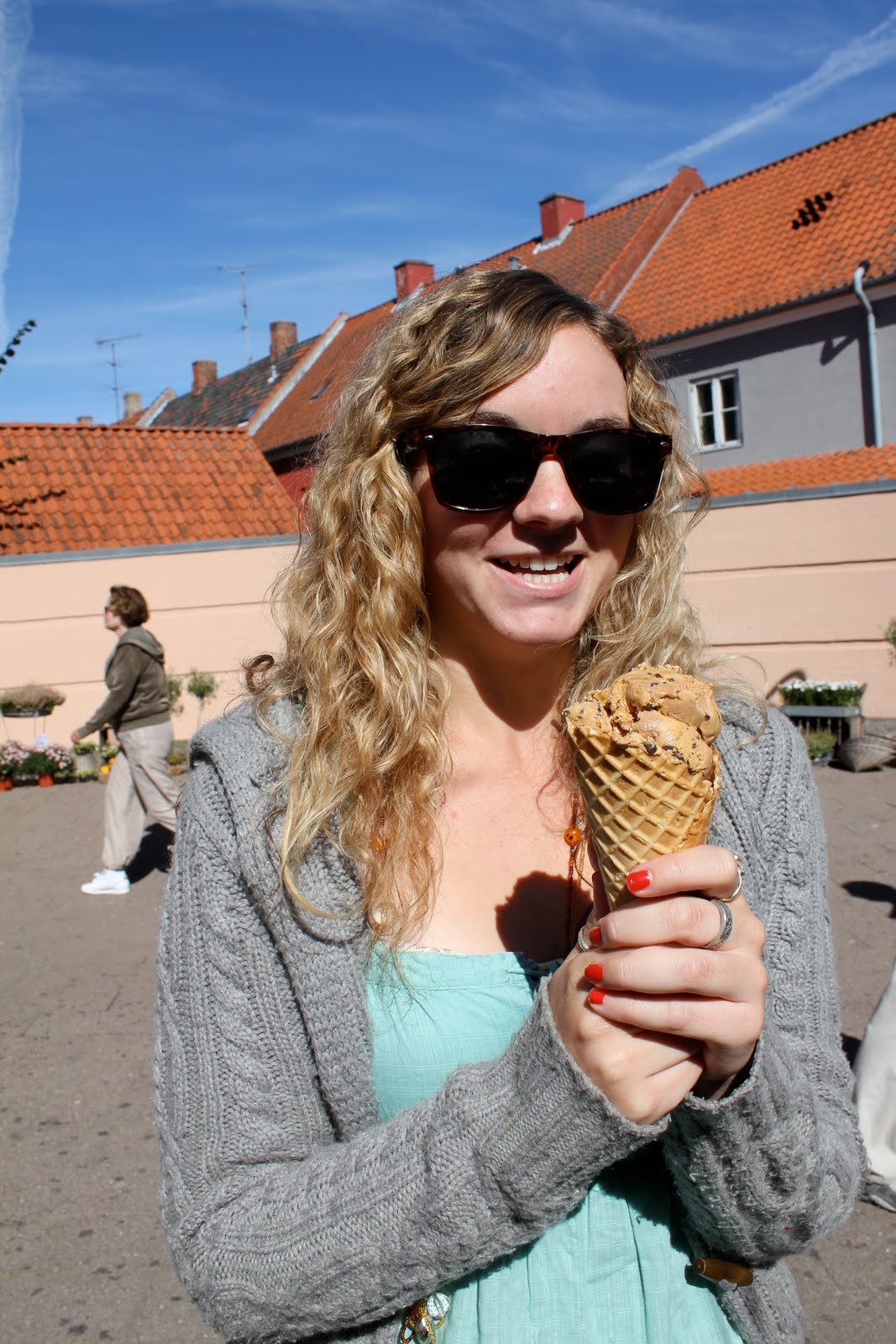
Lucky me- I got one without knowing that!  Not only did I have a delicious scoop of Banana Split ice
cream, but I also learned that there is such a thing as licorice ice cream (which I do not like), as well as a flavor called "Toms", which is butter rum (and I also don't like).  Shelley got "Lion" flavor, which seemed to be a toffee/coffee/chocolate chip variety (I liked that a lot more), and then we walked from the town to the castle, which was always in site out towards the sea.

Shelley- Enjoying her 'Lion' ice cream!
Around the castle are bastions, which are what give the star-shaped form to the grounds of so many castles.  You see, during the Middle Ages, strong thick walls were enough to fortify the typical building.  However, with the invention of the cannon, these walls became incredibly easy to penetrate, ant therefore, useless.  Quickly then, bastions were invented.  Essentially, they are earthen mounds which are build in zig-zagging shapes for stability.  They are fronted by a ditch, frequently filled with water, and backed by an earthen ledge big enough to support troops or cannons.  You enter the fortified ring (ok, star) by a bridge which cuts a hole in the defenses.

The view back to the bridge from the top of the bastions.

From there, you must cross another bridge over a second moat to approach the castle.  Like in many castles, the entry is not on-line with either of the bridges.  In fact, you cross the first bridge, turn right, cross the second bridge, turn left, turn right, go up a hill, and turn right again- this time, under an arch and into the center courtyard of the building.  While this seems tedious or superfluous, it was, of course, another defense mechanism, and kept attackers from gaining too much momentum upon their approach.  In keeping with Shakespeare's vision, the process of entering the castle suggests an old, stone structure with long, dark hallways, and dark, brutal dungeons.  In fact, I came to Helsingør expecting just that.  But again, Shakespeare was either taking creative liberties, or was simply mistaken.  The castle was actually built in the mid 1600's, making it a Renaissance Castle similar to many of the Chateaux one can find in the Loire Valley of France.

Defensive wall and moat, with Kronborg visible in the distance.

 At one time, it probably did have some resemblance to Hamlet's castle, as the original Kronborg was built in the 1420's.  Like many things in Denmark, it burnt down, not once, but twice (the second time, being rebuilt in the late 1500's).  The final, THIRD version, was constructed by Christian the Fourth, perhaps the most famous Danish King.  He was a prolific builder, creating Christianshavn, the hedgehog-shaped island in Copenhagen, Rosenborg Castle (where the national treasury is now), and the Stock-Exchange building.  He was also a prolific war-maker, but not a very good one.  He lost every war he entered into... and died leaving the country almost completely in debt.

The central courtyard of Kronborg.


The castle itself was beautiful from the outside, but rather sparse on the interior.  You see, Sweden is very, very close to Helsingør.  In fact, that was why the castle was built in the first place- at one point, Denmark owned much of what is now Sweden, and at Helsingør a bottleneck for ships formed.  This made for very lucrative business for the Danish government, taxing ships along what was the most profitable shipping route between the Northern countries and the rest of Europe.  And when I say Sweden is close- I mean CLOSE.  All along the coast (at least this far North of Copenhagen) you can see it across the water.

The view from the back side of the Castle, out over the Strait.  And yes, that's Sweden over there.
 Unfortunately, when Sweden gained its independence, this was not particularly safe for Denmark.  I guess they didn't get along very well, and Sweden, holding a grudge for all of those years of being forced to be Danish, invaded, taking most of the precious objects from the castle.  Also, Kronborg was used as a prison from the 1700's to the 1900's, and was a military building until the 1920's.  The beautiful chapel, in fact, was the storage facility for the army's gunpowder (think of how well that worked for the Greeks at the Parthenon!).

The great hall, set up for an intimate opera, the next evening.  Note the bare walls...

But, as of 2000, the Castle is on the list of UNESCO World Heritage Sites.  It has been restored, slowly, although much of the original furnishings have either been destroyed... or are now in a royal household or museum in Sweden somewhere...  I think the most fun part of the castle by far was the cellar, called the Casemates.  For a few moments, it did feel like Shakespeare's Hamlet was leading the way- it was incredibly dark, and maze-like, with low arcades and tunnels at every turn, and candles lighting the way vaguely.  The Casemates are also home to the famous statue of Holger Danske ("Holger the Dane"), a mythical defender of Denmark who will come to life and take action if ever Denmark is in need of his aid.  During WWII, when Denmark was "peaceably" occupied by the Nazis, the Danish Resistance movement was named in his honor.

Holger Dansk, the heroic Viking, pondering the fate of his country.
Because there is so much to talk about, I have divided this post into 2 volumes.  In Part III and IV:
    Greve Strand & the DIS Picnic

Wednesday, August 25, 2010

Initial Impressions

I've been in Copenhagen for a week now, and I'm only finding time to write this due to an unfortunate decision by one of my new professors to NOT photocopy a required reading and put it in the compendium (a large bound packet of readings and information) that we were given for the course.  There are perhaps 30 students and 8 books, all but two of which have been put on reserve.  The other two have been taken without being checked out.  I know this because there are no librarians in the library until 5 today... and I was told that there were 2 copies on the shelves this morning.  So... I am waiting until I can get my hands on one and leave.

The reason I'm in such a hurry to go home is that home is pretty far away.  Something between a 45 minute and 1 hour commute, depending on if I catch the exchange just right and if there is railway traffic.  I didn't even know there was such a thing.  The town I live in is called 'Greve' (pronounced grey-ve, with the r rolling in the back of the throat).  And technically, it isn't even a town- it's a village.  There are maybe 2,000 people, which may be an overestimate, and one very cute village store.  They have their own train station, serviced by the 's-tog', the regional trains of Copenhagen, E and A route.  BUT my family lives a good 5 kilometers from the station, which a reasonable bike ride, but not a reasonable walk.  So, I have to take a bus, the 600S, from my closest stop, about a block away, to the station.  And, I would ride my bike, because I've been told by my host parents, Henning and Inga, that it's usually faster and more convenient, but the weather forecast has called for rain and strong winds since I've been here.  And that isn't really preferable biking weather to me.
In fact, the weather here hasn't been entirely preferable.  Or really preferable at all.  To anyone.  I guess this has been an incredibly wet season, and they have gotten twice as much rain as normal this month.  And it's so much rain that not even the farmers like it.  I would know, Henning used to be a farmer.  What I find most impressive about the weather however, is how quickly the weather changes.  The clouds move with visible speed in the sky- like nothing I've ever seen before; a downpour turns into sun in a matter of minutes.  Yesterday, in fact, I went with some other DIS students to a cafe after we were done with orientation, and it rained and stopped two or three times while they were eating (and I was drinking a chai latte).  It was actually funny to watch, because the Danes seemed to understand this fickle weather, and the pedestrians and cyclists simply moved off of the streets and sidewalks to wait it out under store awnings.  For a few minutes the streets were completely empty (something I have not seem any other time here), but then, as soon as it had begun, it ended, and everyone went back on their way.
Probably the second most interesting thing I have begun paying attention to is the food here.  First of all, it is incredibly expensive.  Well, I guess everything is incredibly expensive- they say about twice as much.  But, I mean, it's a little ridiculous.  I street vendor hot dog, a pølser (which is really, really good by the way) is 25 DKK, which translates to about 5 dollars.  A hamburger with fries at a restaurant can be as much as 22 dollars.  Yikes!  However,  I've found all of the food very delicious- they seem to really like salt, sugar, butter, and pork, so everything is very flavorful.  I think a lot of things they eat are probably looked upon with a little skepticism by foreigners (especially Americans, who have little experience with European food culture), but mostly I've found it appealing.  They eat a very dense rye bread (which, I think they think is the only kind of rye bread) almost religiously, and frequently use it to make open-faced sandwiches called smørrebrød.  It frequently involves both butter and pork on top.  But, while many DIS students I've spoken with seem to detest the rye bread, I actually really like it on the smørrebrød.  The butter (or, alternately, mayonnaise) adds the necessary moistness to the bread, and I like the flavor.  Especially when put in a packed lunch the evening before, and then let to sit overnight.  I was really proud of myself, actually, because last night I made my packed lunch (a common Danish way to avoid the expensive prices of restaurants in the city) for myself.  In my little box (with a picture of the Sun Maid raisin lady on it) I had one open-faced sandwich, made with mayo and salami, a carrot, a sweet Danish pickle, a brownie cookie, and a PB&J on white bread.  Which, for the record, was a big deal.  Peanut butter is hard as hell to come by here.
My packed lunch of smørrebrød, tomatoes, and a cookie the first day.
But, I have probably the nicest host family I could imagine.  They have had 3 previous DIS host students, and seem to already understand everything I am going to need.  So, they had already found the peanut butter.  And nutella.  Plus, Inga is a really amazing cook.  I hope someday once I'm settled she'll teach me how to cook some of the food she has been preparing, but so far she's done it all.  And it has all been SO good.  We had frikadeller (pork and beef/veal meatballs that are panfriend), hakkebøf (basically beef patties, served with cooked onions and gravy on top), grilled pork, rice, salad, and of course... potatoes.  I'm getting the impression that Danish people really like potatoes.  Not that I mind.  Potatoes are a pretty unoffensive starch.  Besides that, they definitely like beer.  Locals like Tuborg and Carlsberg are available in every corner store (most of them a 7-elevens), and because there is no law against open alcohol containers in Denmark, they are frequently seen on the train and bus at all hours.  I guess drinking is legal at the age of 16 here, and like in the US, they start earlier than that.  So, by the time they reach 21, they have very tolerant livers.
I guess you could say Greve is a little inconvenient because of the travel time, especially if I want to stay out at night (when the bus stops running, and the train only comes once an hour or so), but I like it nonetheless.  The house is brick covered in a thin, sleek layer of plaster, with a red tile roof (I thought I was leaving those in California!).  Some neighboring houses even have real thatch roofs! The village then, has the feeling of a quiet, quaint, old countryside.  Best of all about the house, they gave me a big room all to myself with a breathtaking view out over a wheat field.  In the morning, when the sun is still low, you can see the rows made by the combines, and the rhythm and color is so beautiful.  I've never lived in the country, so I guess I'm probably just not used to it, but really.  Every morning out my window.  And on my way to the bus.  And on the way home in the afternoon.  It's probably one (of several) highlights of my day.  Another thing I like (slightly less) about my room is the bed.  When I first walked in, I thought I didn't have one, because all I saw was a desk, a crib (for one of my host sister's friend's daughter), a love-seat, and a couch.  But, it turns out a very frequent substitute for a 'real' bed in Denmark is either a futon or a couch with a roll-out bed.  And no, I don't mean like a bed hidden under the couch.  I mean, there is a bed rolled up behind the back cushions.  When you're ready for bed, you take off the cushions, undo Velcro straps on either end of the couch, and unroll a pillow-top, a bottom sheet, and a comforter, as well as a pillow.  For the record, the comforter thing is pretty cool.  They are incredibly warm, and very soft and cozy.  But this time of year since it isn't too cold yet, they can be too warm, so I usually end up curled to one side of it, or with the bottom half of me sticking out from underneath.
The view as I walk out the front door in the morning.
Aside from the basic living conditions, and cultural norms, I have seen some amazing places here.  Over the course of orientation activities and personal wanderings, I have seen: 1.) The Støget, which is the longest pedestrian shopping walk in the world and has expanded itself into other side streets as well.  It has a slight touristy impression, but I guess I can't complain as I would say for now I still count as a tourist.  But it also has some high-end shopping, and some more reasonable shops too, like H&M.  There are also lots of food carts and stands set up along the way.  Mostly, the options are shwarma or pølser, which are the least expensive anyway, but there are also gelato stands, a few cafes and restaurants in the plazas and squares (called torv), and even some fruit vendors.  2.) The Botanical Gardens, made with a lake that ties back to Medieval bastions in the old, old city.  The walks are winding and quiet, all with great views of either the lake or the surrounding historical buildings.  There are also self-guided tours that look at poisonous plants, or conversely, biblical plants.  3.) The Royal Gardens & Rosenborg Castle, which are found together across the street from the Botanical Gardens.  The Royal Gardens are much more formal, with straight walks and alleys under perfectly groomed trees.  There are also expansive lawns where Danes go to have picnics and sunbathe.  The Castle is also very old, dating back to the Renaissance.  It still has the original moat, as well as guards who patrol the grounds with very large guns, but like the British, completely ignore everything and everyone but their duty.  The Castle itself had gardens, again, very formal, but very beautiful, full of roses.  4.) Nyhavn (pronounced new-haav'n), the pictorially famous canal/port section of the city.  Honestly, I understand now why they take so many pictures of it.  Once the 'new' part of the city (ny means new, and havn means harbor), the buildings have lasted longer than in most other areas, and in fact, are some of the distinguishable oldest, at least the oldest in a large quantity.  The buildings are also a mix of stunning colors- red, yellow, white, blue- all along the street, which has in its center a canal full of (also) very old looking boats.  It feels a little like going back in time, except for all of the people walking around.  It was very, very crowded. 
A view of the canal, boats, and buildings of Nyhavn
5.) Rådhus, which means 'town hall'.  It's a neo-gothic building, which I don't greatly appreciate, but it has a grand stage presence.  Why?  Well, most obviously, it's quite large, but more than that, it is fronted by a large plaza, which seems to dramatically increase its perceived size.  Also, this square, lines with flashing signs and huge posters, has almost a hint of Times Square in it, and the overwhelming quantity of information makes the building look majestic and simple in comparison.  On the inside, there is a natural-light (but indoor, thank goodness) courtyard where events are held.  For us, it was orientation speeches, which were quite boring and long-winded.  What was nice were the many Danish flags hanging from the walls, and the 'pancakes' served to us afterward.  I put quotations around pancakes because that is what they were called, but they were really custard filled crepes.  What they are called in Danish, I am not sure, because I asked and was never told.  Hm. 
The DIS Opening Ceremony in the Raadhus Courtyard
6.) Parliament, the planned original home for the royal family, which is not where they live now.  But it is where the democratic government is run, as well as the justice system, and it is the location of the Queen's weekly council.  Apparently, the building is relatively new, given the fact that there were 2 others before it, both of which burned down in fires.  Again, it's big and imposing, but beautifully, crafted.  7.) Tivoli, perhaps the happiest place on earth.  I know, I know, people say Disneyland is the happiest place on earth BUT think about it this way: the Danes are the happiest people on earth, and this is their amusement park.  Plus, rumor has it that Disneyworld was inspired by Tivoli, with its international themes, and most importantly, its castle.  The lines for rides are shorter (although they do cost money on top of the entrance fee... leave it to a Dane), and there are shows and events that are presumably free all night long.
The gardens of Tivoli at night.

For now, I think I'm out of words.  Too bad, since I still have 45 minutes before a librarian shows up to let me check out a book.  However, in closing remarks: I like it here, in spite of the poor weather, and am looking forward to the even colder, wetter months (even though that does mean several fewer hours of sun), and to learning some the words to this very complicated language.  Classes start tomorrow, and then some structure returns to my life.  But, I plan to find some time for more unstructured wanderings and explorations to blog about very soon.